Compare
Quiet garage door openers for a Scottsdale home with a bedroom over the garage
For a bedroom over the garage in Scottsdale, the quietest setup is a wall mount jackshaft on a torsion door, followed by a belt drive with a DC motor. Both only work if the door itself is quiet, because the opener is only one source of the noise. A belt drive on dry rollers and flat spotted hinges is a quieter rattle, not silence. The 2 fixes that pay off most are the cheap ones: nylon rollers and a lubrication pass on the hinge pins, before any motor is replaced. Tell us the door you have and where the bedroom sits, and we call you back.
Openers
Which opener is quietest for a bedroom over the garage?
A wall mount jackshaft, because it deletes the ceiling unit that vibrates the room above. A belt drive is a quiet ceiling mounted type, HomeGuide lists direct drive as the least noisy and screw drive as quiet too, and chain drive is the noisy one.
| Option | What it fixes | Best for | Skip it if |
|---|---|---|---|
| Wall mount jackshaft | Removes the ceiling rail and the unit over the car | A bedroom or office directly above the garage | Extension springs, or no side wall beside the shaft |
| Belt drive, DC motor | Rubber belt and soft start instead of metal on metal | Most homes with a standard ceiling unit | The door hardware has never been serviced |
| Screw drive | One rail, no chain to slap, steady on heavy doors | Heavy doors and long service life | A tight budget |
| Direct drive | The motor travels on a stationary chain | Quiet without changing the spring setup | A tight budget, or a door out of balance |
| Door side quiet kit | Nylon rollers, hinges, bearing plates, lubrication | Every door, before anything is replaced | The rollers are already new |
Sources
The noise has 3 sources, and only one is the motor
The drive is the first, and it is the one the internet talks about. The door is the second and usually the loudest: steel rollers on a dry track, worn hinges, a loose bottom bracket. The third is the building, because the opener bolts to ceiling joists and that ceiling is the floor of the bedroom.
Clopay's component guide says it plainly: steel rollers last longer and run noisier, nylon rollers run quieter with less upkeep. The lubrication rule surprises people. Clopay says to use silicone on hinge pins, roller bearings, springs and bearing plates, never on the tracks and never on nylon rollers, because lubricant on a track makes the rollers harder to move.
Arizona moves the schedule up. Phoenix ran its second warmest year on record in 2025, and Clopay says dusty climates may need lubricating more often than its usual interval of every 3 to 6 months.
Good to know
The 5 options, ranked for this house
The order follows this site's angle: a design forward Scottsdale house with living space over the garage. The option that removes the machine from the ceiling comes first, and the cheap fix that helps all 4 comes last.
Wall mount jackshaft
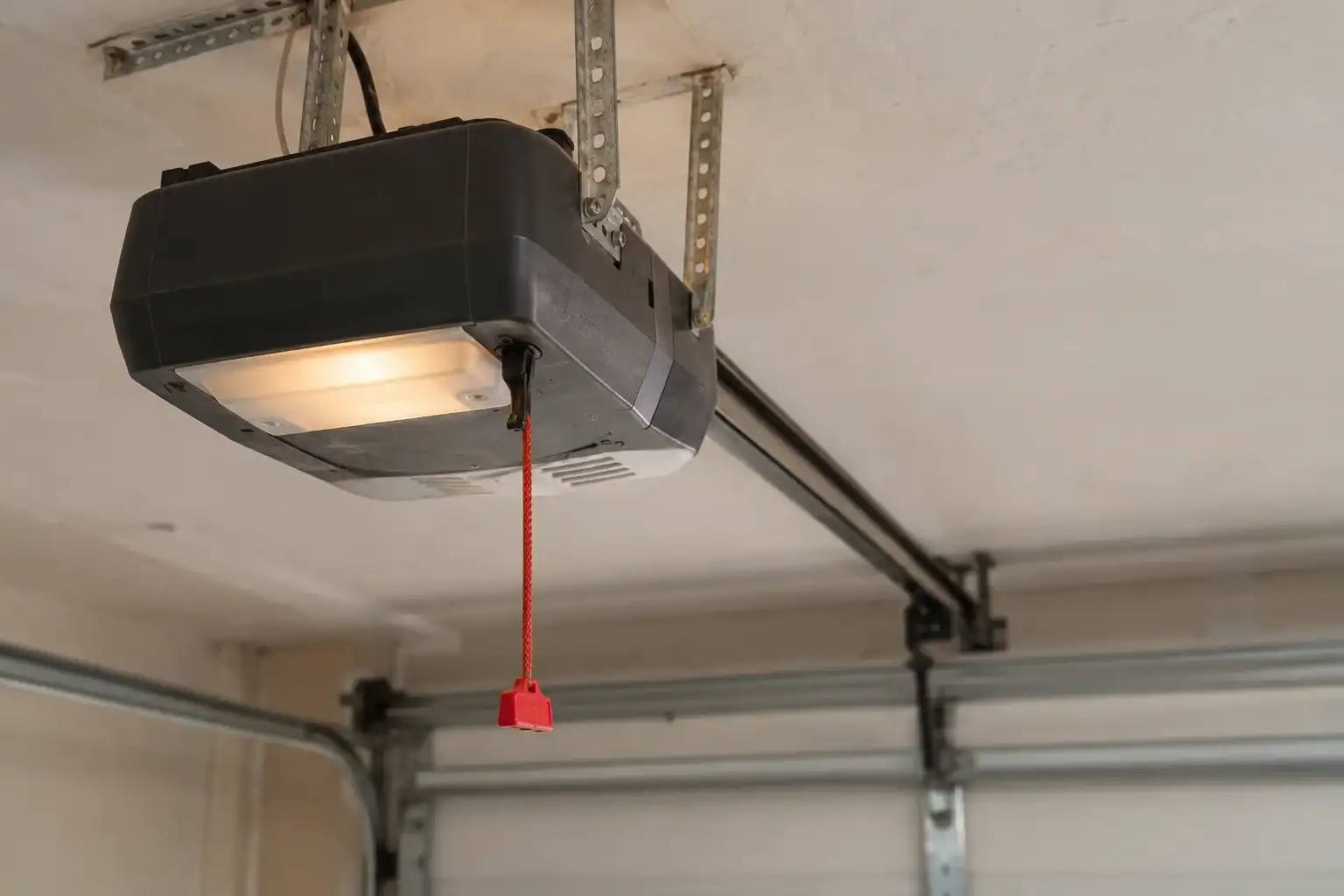
A small motor on the wall beside the door turns the torsion bar instead of pulling a rail across the ceiling. It is the only option that removes the machine from the room above.
Best for: a garage with a bedroom, office or bonus room directly above it.
Fits: a door with a torsion assembly, meaning the spring across the header, plus a few inches of side wall. Height stops mattering, so it also works under a low ceiling.
Skip it if: the door runs on extension springs. DASMA's checklist is blunt about those needing a safety cable through the center, and a wall mount on that door is a conversion, not a swap.
The Arizona note: a jackshaft sits in the hottest air in the garage, so a west facing wall puts the motor in the worst spot in the building.
Belt drive, DC motor
A steel reinforced rubber belt replaces the chain on the same rail, and a DC motor ramps up and down instead of snapping on. It removes the clack at the start and the slam at the end.
Best for: a standard ceiling opener in a house where the garage shares a wall with a bedroom.
Fits: torsion or extension springs, one or 2 doors, a normal ceiling height.
Skip it if: the door has never been serviced. A belt on dry rollers is the same rattle at lower volume.
The Arizona note: the belt is rubber, and rubber in a hot garage can age faster than the box assumes. Check it at the tune up.
Screw drive
A single threaded rod turns and the trolley walks along it. No chain slaps the rail, so it stays quiet for years with little attention.
Best for: a heavy door, or an owner who wants one less part to service.
Fits: most torsion doors, and it suits a heavy door.
Skip it if: the budget is tight, since HomeGuide puts screw drive above chain and belt on price.
The Arizona note: dust works into the threads, so the rail wants a wipe down at the tune up rather than grease.
Direct drive
The motor itself travels along a stationary chain, so the trolley and the drive are one part. Fewer moving pieces means fewer things to rattle, and HomeGuide lists it as the least noisy ceiling type.
Best for: quiet without changing the spring setup.
Fits: a ceiling that can carry the load, and a door that is already balanced.
Skip it if: the budget is tight, since the unit sits at the top of the opener range.
The Arizona note: heat dries the lubricant on the moving motor, so the wipe down matters more than the drive type.
Door side quiet kit
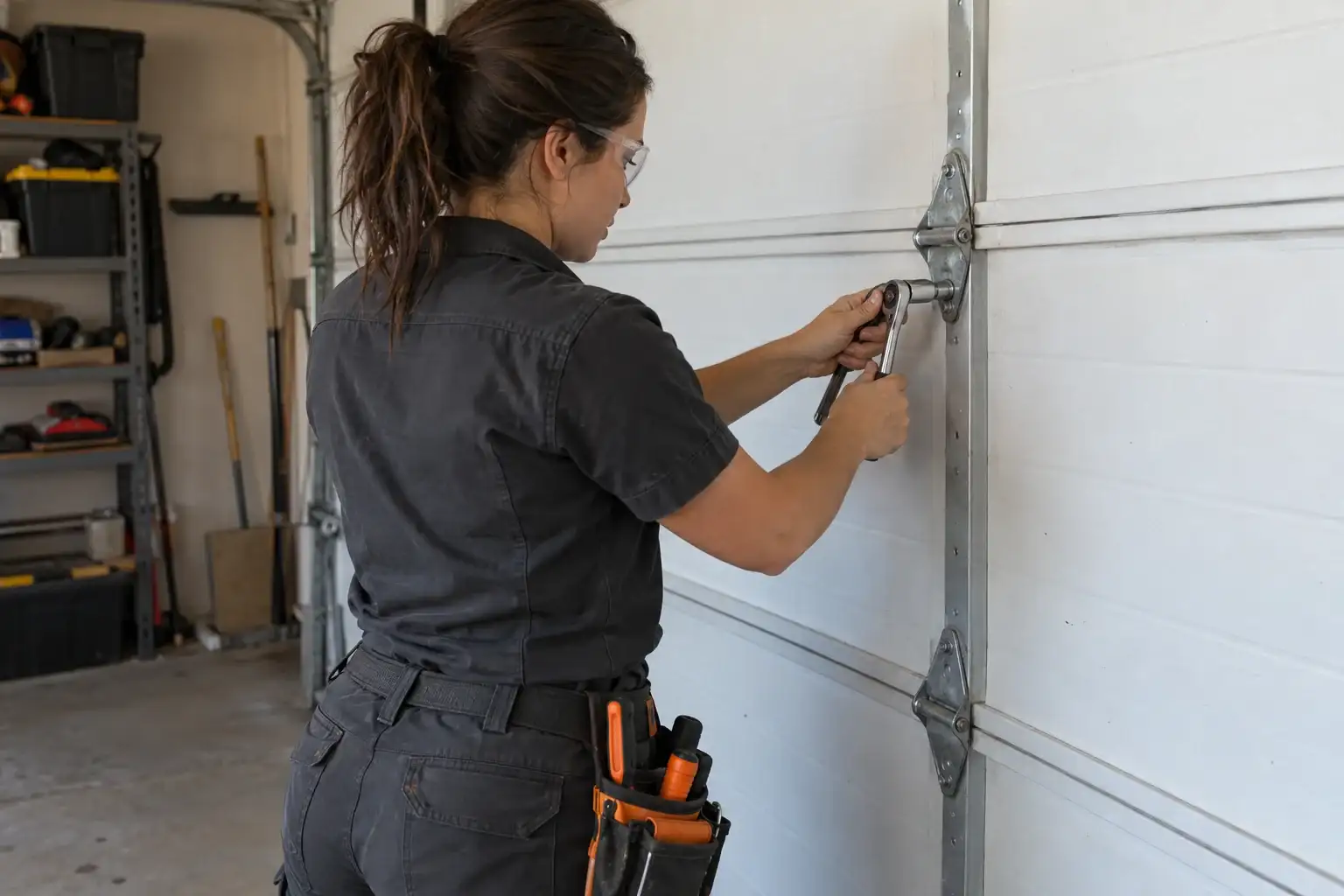
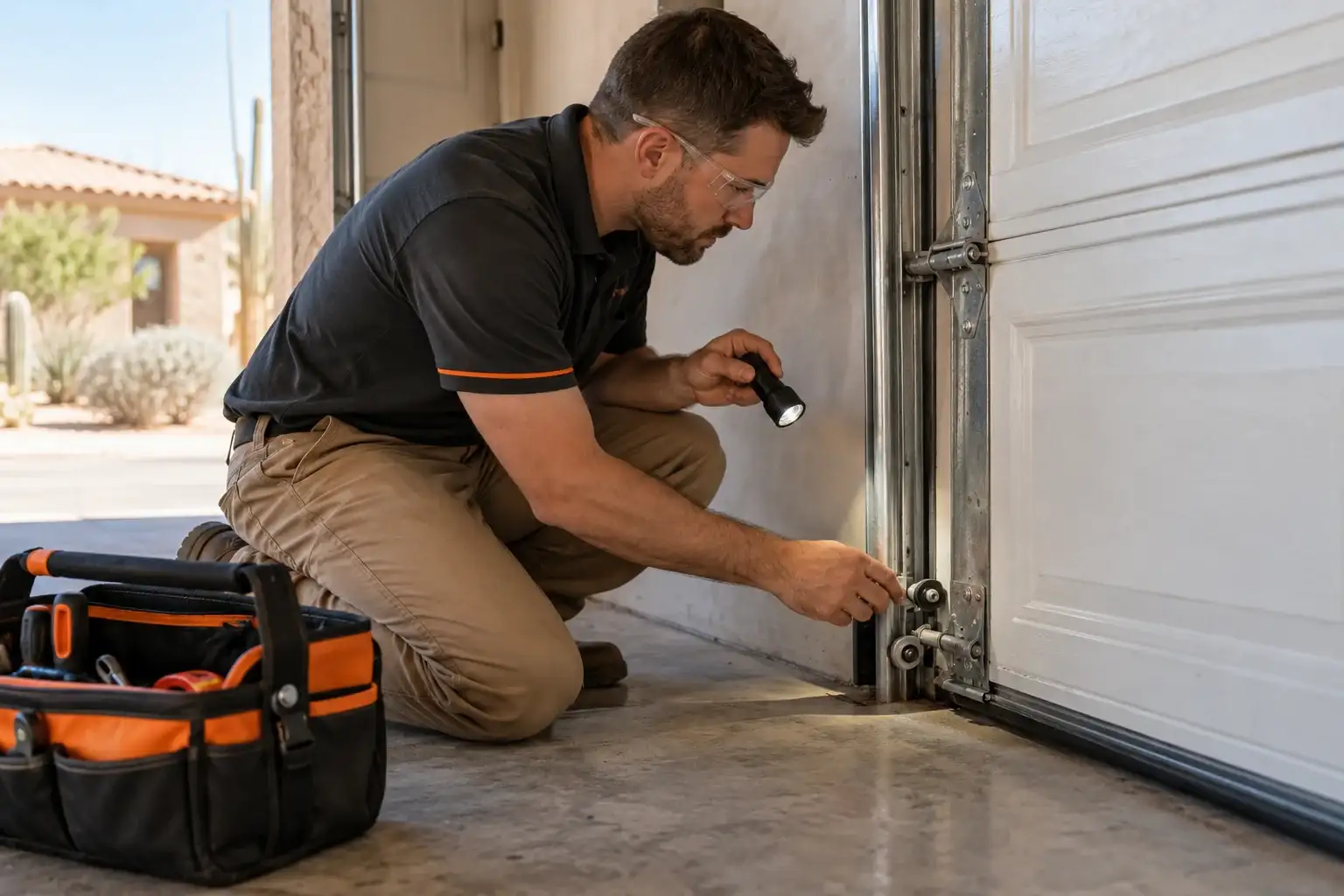
Nylon rollers, new hinges, bearing plates and a lubrication pass. This is not an opener, it is the reason an opener sounds the way it does.
Best for: every door in the Valley, especially one that has never been serviced.
Fits: any sectional door, on its own or with a new opener.
Skip it if: the rollers are already new, or the door is so far out of balance that the hardware is not the problem.
The Arizona note: this is the item that pays back every summer, because dry hardware gets louder as the grease cooks off.
How it works
What it runs
HomeGuide's 2026 figures put an installed opener at $300 to $900, with the unit at $150 to $500 and labour at $150 to $400. By type, the unit alone is $150 to $250 for chain, $200 to $450 for belt, $200 to $500 for screw and $300 to $500 for direct drive. A tune-up runs $100 to $250 in HomeGuide's repair guide.
How it works
Next step
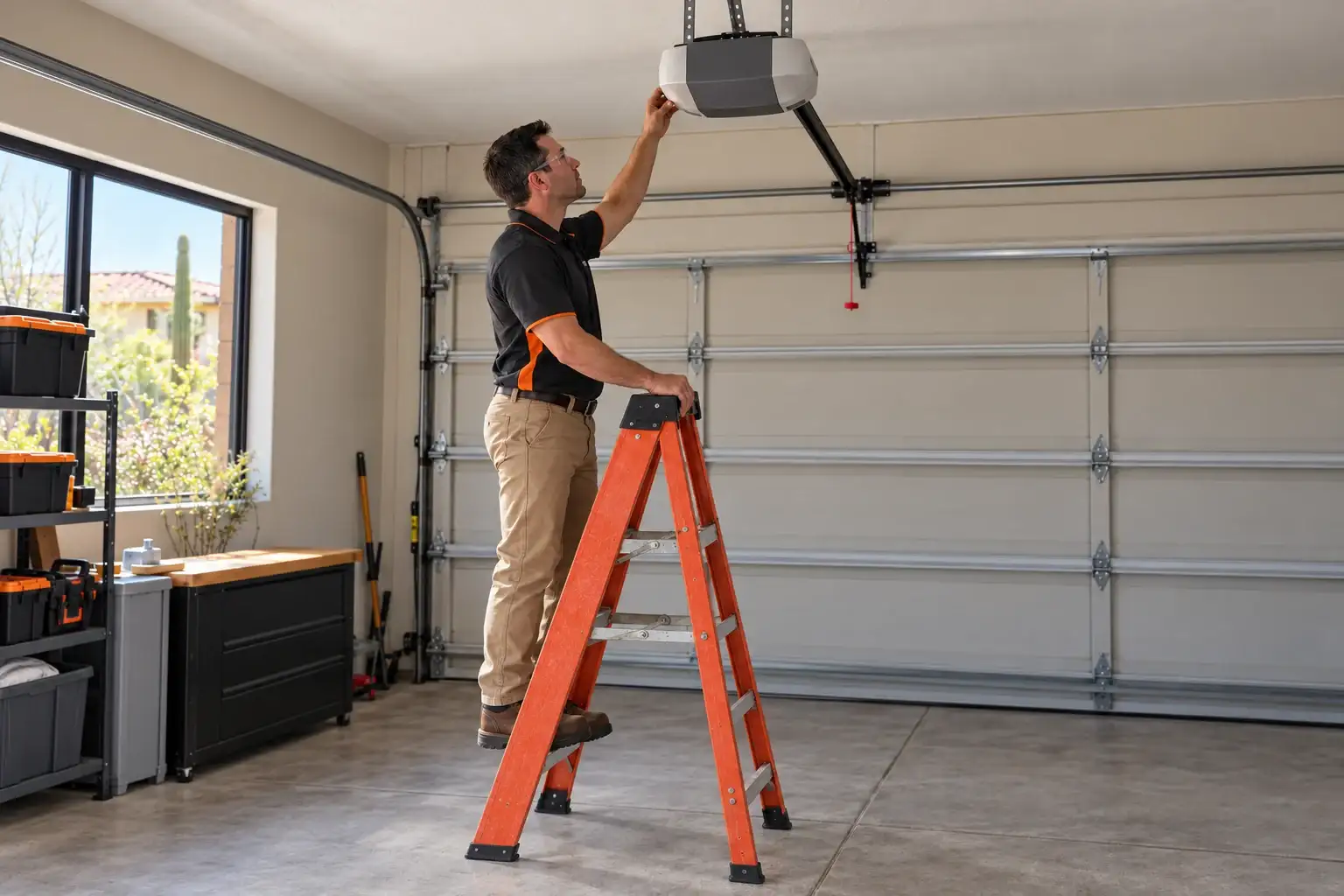
What decides it is on the door, not the spec sheet: torsion or extension springs, side wall beside the shaft, what the door weighs, whether the frame is square, and what the ceiling above is made of. A tech checks those before an opener is ordered, and the photo eye reversal test is part of the visit.
Tell us which door is loud and what sits above the garage, and we call you back.
For the narrower question, chain drive vs belt drive opener in Scottsdale covers the 2 ceiling types, smart opener vs regular opener covers the connected units, and garage door opener repair in Scottsdale covers the repair before the replacement.
3 questions
Questions people ask
Still have a question? Call (480) 885-5136 and say what the door is doing.
Will a belt drive make my door quiet?
Only the drive part. Dry rollers and worn hinges still rattle. Replace the rollers and lubricate the hinges first, then judge the opener.
Does ceiling insulation help with the noise?
It reduces the sound that reaches the room above. It does not change the door, which is why the 2 fixes are often done together.
Can I quiet the opener I already have?
Often, yes. Nylon rollers, a lubrication pass and a balance check remove most of the noise for a fraction of an opener. Replace the opener when the motor fails, not when it is loud.
Sources
Sources
- Clopay, Garage door components guide
- Clopay, How to properly lubricate garage door components
- DASMA, Technical Data Sheet 167, Residential sectional garage door and operator checklist (opens in a new tab)
- HomeGuide, Garage door opener installation cost
- HomeGuide, Garage door repair cost
- Federal Register, Safety standard for automatic residential garage door operators (opens in a new tab)
- National Weather Service Phoenix, Year in review 2025 (opens in a new tab)
- City of Scottsdale, Home improvement and permits (opens in a new tab)
Last checked: November 2026