Compare
Which garage door finishes hold up to west-facing Scottsdale sun
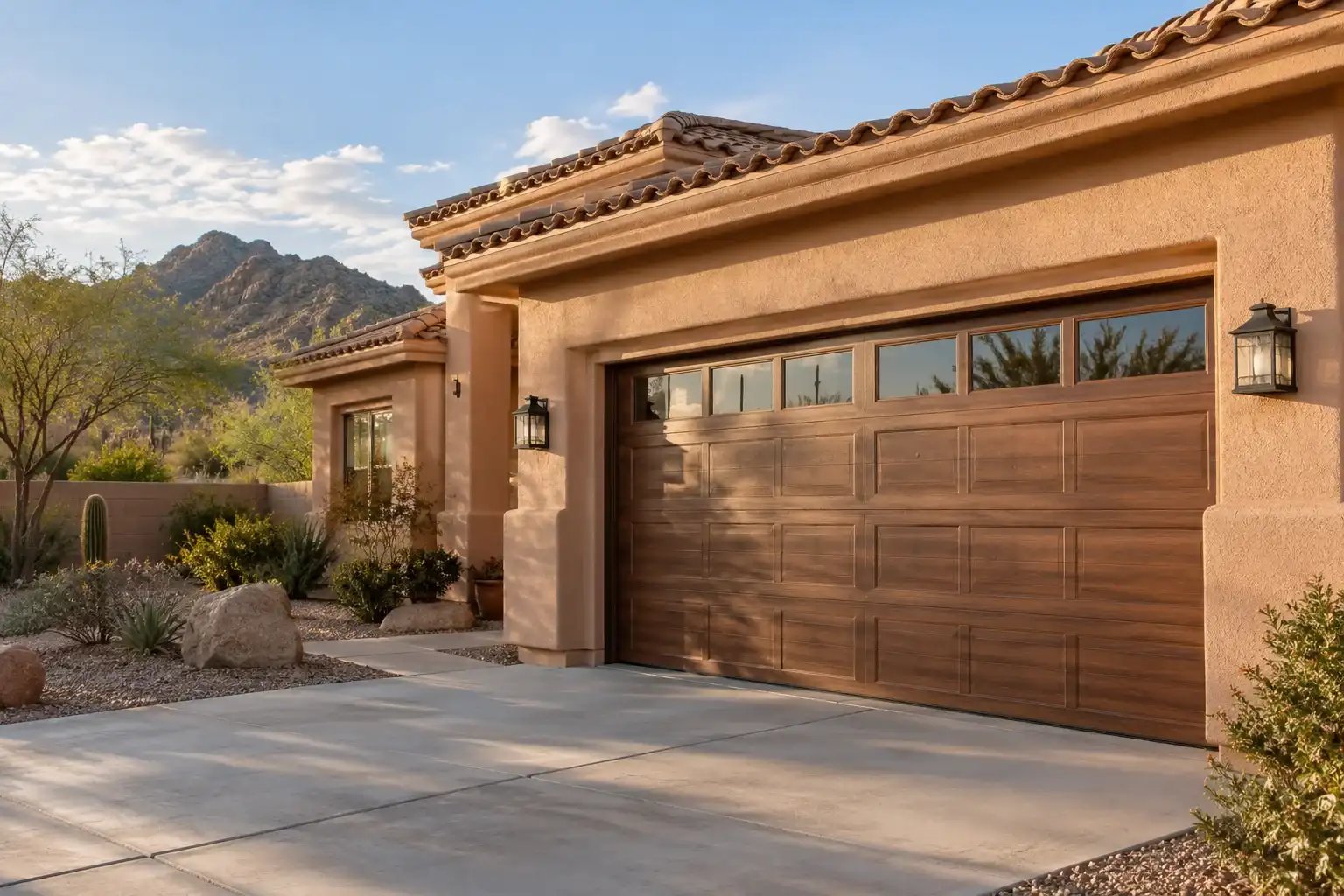
The finishes that hold up on a west-facing Scottsdale wall are factory-finished steel, anodized or powder coated aluminum, and a composite wood-look skin. Real wood with a film finish is the one that lets go first. Sun exposure decides this more than heat does, because UV breaks the coating down and heat finishes the job. Here is what the color charts never say. The finish is a system, not a color: a baked factory film over treated steel, an anodized surface that is part of the aluminum, a sprayed powder film, or a moulded composite skin. Two doors in the same bronze differ completely in year 5 depending on which of those 4 they are. Tell us which wall the door faces and what it is made of, and we call you back.
Arizona heat
Which garage door finishes hold up to west-facing Scottsdale sun?
Factory baked steel and anodized aluminum last longest on a west wall, powder coat is close behind, and a composite wood-look skin holds its color better than real wood. Real wood is the one that needs sanding and sealing, and it is also the one that fails soonest in full afternoon sun.
| Finish | What it is | Holds up to sun | Fails when | Price note |
|---|---|---|---|---|
| Factory baked steel | Factory baked film on treated steel | Well, and color matched doors are common | The film is chipped at an edge and the steel under it starts to rust | Set by the door, not the finish |
| Anodized aluminum | An electrochemical surface that is part of the metal | Very well, no film to peel | It is scratched deeply, which cannot be polished out | Set by the door, not the finish |
| Powder coated aluminum | Sprayed powder cured into a film | Well, with the widest color choice | A chip at an edge lifts the film | Set by the door, not the finish |
| Composite wood-look | Fiberglass filled composite skin over a steel core | Well, and it does not rot, warp or crack | The texture holds dust and the finish dulls if it is never washed | Set by the door, not the finish |
| Real wood | Solid or veneered wood, stained and sealed | Poorly, without annual work | UV dries the surface, opens the grain and lifts the finish | Set by the door, not the finish |
Finish does not set the price on its own, so ask for the price of the exact door.
Arizona heat
What the sun actually does to a door
UV breaks the chemical bonds in a coating, and the first sign is chalk, a fine powder that wipes off on your hand. Then the color goes flat, then the film checks and lifts, and by the time it peels the steel underneath is already exposed.
Heat is the second half. A west wall in Scottsdale holds the afternoon sun and the surface runs hotter than the air, and a dark color absorbs more of it. That is why a black door on a west wall is a different proposition from the same door on a shaded north driveway.
Dust is the third, and it is the one nobody mentions. Valley dust settles on the texture of a composite skin and on any film finish, and every time the door runs that grit is dragged across the surface. Rinsing the door twice a year keeps that grit off the finish.
How it works
What happens in year 5 on each one
Factory baked steel either still looks new or has a rust bloom at the bottom edge where the film was chipped. The difference is almost always damage, not sun.
Anodized aluminum looks the same in year 5 as in year 1 unless it was gouged, because there is no film to fail. That is the whole argument for it on a west wall.
Powder coat holds color well and can lose adhesion at a cut edge or a screw hole, where the film is thinnest. A touched up chip is a small job; a film that has lifted along a seam is a panel.
The composite wood-look door does not rot or warp, and its failure mode is cosmetic: the texture traps dust, the grain detail looks flat when it is dirty, and a pressure washer used too close will mark it permanently.
Real wood is the one that needs a calendar entry. Sand, stain and seal, every year or 2, on a surface that takes the worst sun of the day. Skip a cycle and the grain opens.
Good to know
Why the factory finish matters more than the color
A factory finish is applied to bare, treated metal in a controlled line and baked at a temperature a garage cannot reach. A field repaint is a film applied over whatever is already there, at ambient temperature, with the dust of the street in the air.
That is not an argument against repainting. HomeGuide puts a garage door repaint at $100 to $500, which is a fraction of a new door, and a sound door with a faded finish is a repaint, not a replacement. It is an argument for ordering the finish once and washing it, because every repaint is a thinner film than the one the factory applied.
The local rule is worth knowing before the color is chosen. In Scottsdale, exterior painting in Environmentally Sensitive Lands and Historic Property zoning districts needs a courtesy review from the city, and outside those districts the color question usually belongs to the community rather than to the city.
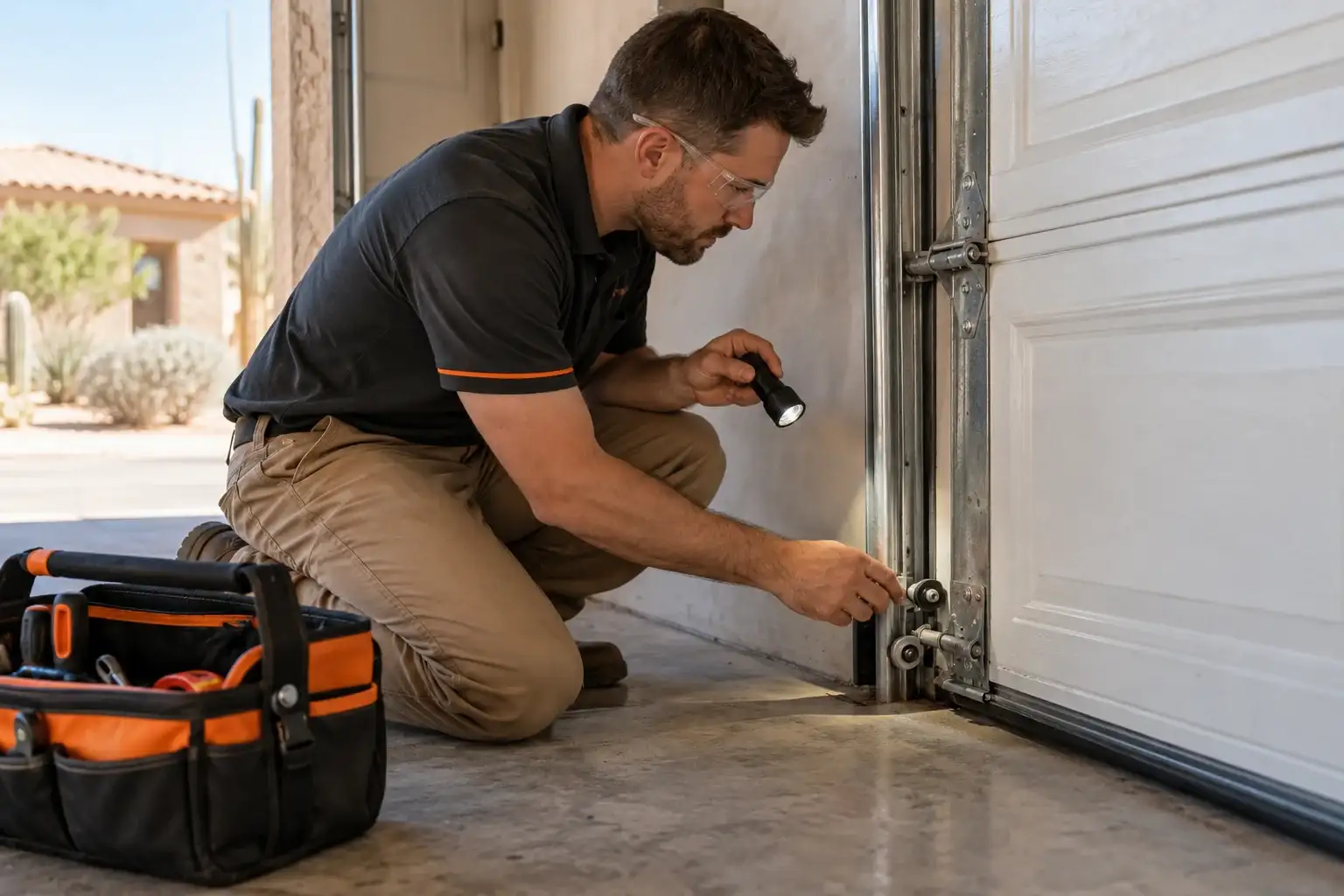
How it works
How a finish and an insulated core work together
A finish protects the panel, and the core decides how much heat gets through it. They are separate decisions, and buyers confuse them constantly.
DASMA measures the whole installed door as a U-factor, and ANSI/DASMA 105 is the method the energy code names, so a U-factor compares across makers while a calculated R-value only describes the center of a section. Solar heat gain and visible light transmittance are separate measured values on any door with glazing. The core question is covered on insulated vs non insulated garage door, and the material argument is on steel vs wood garage door in Scottsdale.
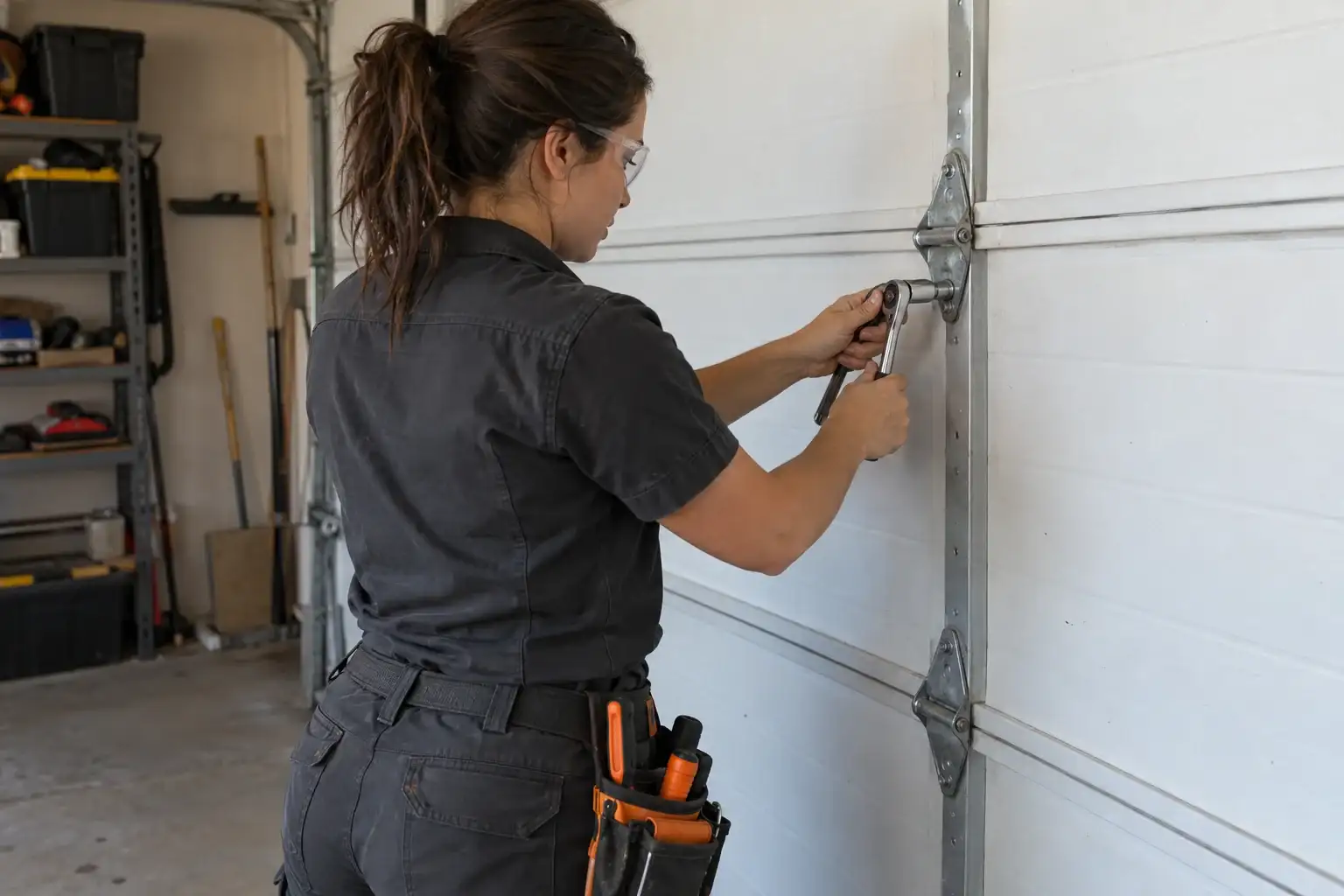
How it works
What to ask before the door is ordered
Ask what the finish is, not what color it is. Ask whether the film is factory applied or field applied, and what happens at a chipped edge. Ask whether the color can be ordered as a factory match rather than the nearest stock color, which matters on a house where the stucco is a specific tone.
Then look at the wall. A west or south facing door with full afternoon sun is the hardest exposure on the property, and a shaded north driveway is the easiest. A west wall is the hardest exposure for any finish, and that is exposure, not a product failure.
How it works
Next step
What decides the answer is measured at the house: which way the door faces, how many hours of direct sun it takes, what the existing finish is, whether the panel is sound enough to coat again, and the core behind it. A tech checks that before a door is ordered or a repaint is quoted.
Tell us which way the door faces and what it is made of, and we call you back.
4 questions
Questions people ask
Still have a question? Call (480) 885-5136 and say what the door is doing.
Does a dark color make the garage hotter?
It absorbs more solar heat, so yes. The core and the glass matter too, and a dark door on a west wall is the combination that runs hottest in July.
Can a peeling door be repainted instead of replaced?
Often, yes, if the panel is sound and the peeling is a film failure rather than rust through the steel. A repaint runs $100 to $500 in HomeGuide's 2026 figures.
Is anodized aluminum better than powder coat?
Anodized has no film to peel and cannot be color matched as widely. Powder coat gives more colors and can chip at an edge. On a west wall with a standard color, anodized is the tougher surface.
Does washing the door really change how long the finish lasts?
It removes the grit that abrades the surface every time the door moves, so it does. Twice a year is the practical interval on a street-facing door in the Valley.
Sources
Sources
- DASMA, Technical Data Sheet 453, Environmental considerations for exterior doors (opens in a new tab)
- DASMA, Technical Data Sheet 196, U-factor on garage doors (opens in a new tab)
- Clopay, Avante aluminum full view product information
- Clopay, Canyon Ridge Modern garage doors
- Clopay, Garage door components guide
- HomeGuide, 2026 garage door prices
- HomeGuide, Garage door repair cost
- City of Scottsdale, Home improvement and permits (opens in a new tab)
- National Weather Service Phoenix, 1991-2020 normals (opens in a new tab)
Last checked: November 2026